Competition for the iRobot Scooba: Evolution Robotics Mint

Mint Robot Floor SweeperIn case you’re not sure what this site is about, it’s about robots that clean. It’s actually mostly about robot vacuum cleaners, but lumped into that I think it’s fair to include other robot cleaning devices. And it’s been a busy week for robotic cleaning. The Consumer Electronics Show (CES) is going in Las Vegas, and today Evolution Robotics Inc. announced their new venture into the robot floor cleaning market, Mint. Mint is designed to be an automatic cleaner for hard surface floors. It can wet mop or dust using cleaning cloths such as the Swiffer dry and wet cloths. Pledge also has such cloths. So you just pop a cloth on it, put it on the floor, press a button, and let the robot take over.

Paolo Pirjanian, the CEO of Evolution Robotics, had this to say. “Similar to how the once manual chores of washing dishes or doing laundry evolved with the invention of the dishwasher and washing machine, floor cleaning has officially been replaced by an automated appliance that achieves the same result, if not better, than previous manual methods. To do the job well, Evolution had to rewrite the book on how floor cleaning is done. Mint packs aerospace-grade technologies that were specifically tailored to deliver consumer with an appliance that cleans like they do, while still providing a hassle-free experience.”

To design the robot cleaner, Evolution brought in Yves Behar, an industrial designer. Together they worked to make a robot that would eschew a “techie” look and fit in better with home decor. They were especially looking to design a robot that would look like an appliance. As you can see, it is very geometric and black and white. Actually, it is quite sexy looking.

Like iRobot Roomba vacuum cleaners, the Mint is autonomous and designed to clean floors without human intervention. The cleaner has different actions depending on whether the cloth is wet or dry. With a wet cloth, the robot uses a “special mopping motion” (back and forth) to dissolve dirt and grime and get the floor cleaner. Mint floor cleaners are guided by Evolution Robotic’s NorthStar technology, which it uses to keep track of where it cleans. This works by projecting a beam on the ceiling that the robot can detect and follow. Like some other robot floor cleaners, it maps out the room and plans where to go next.

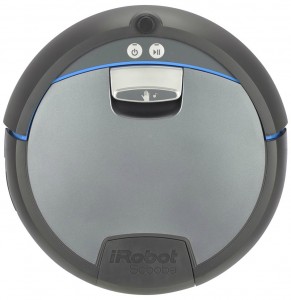
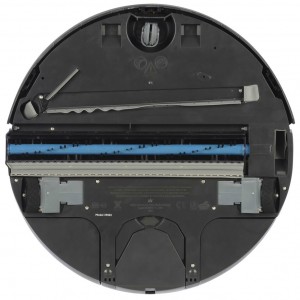
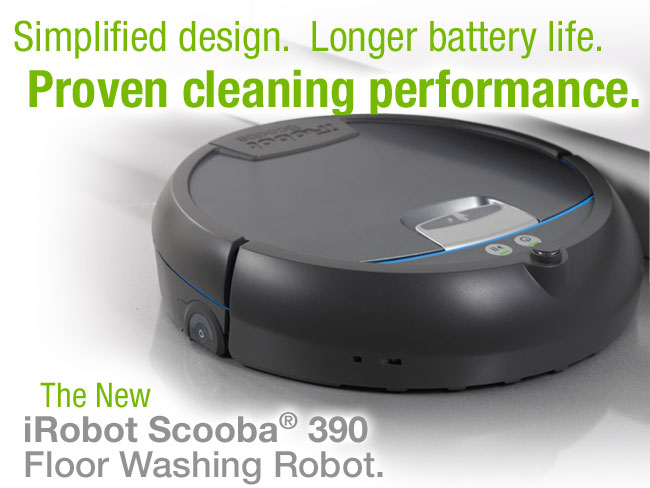
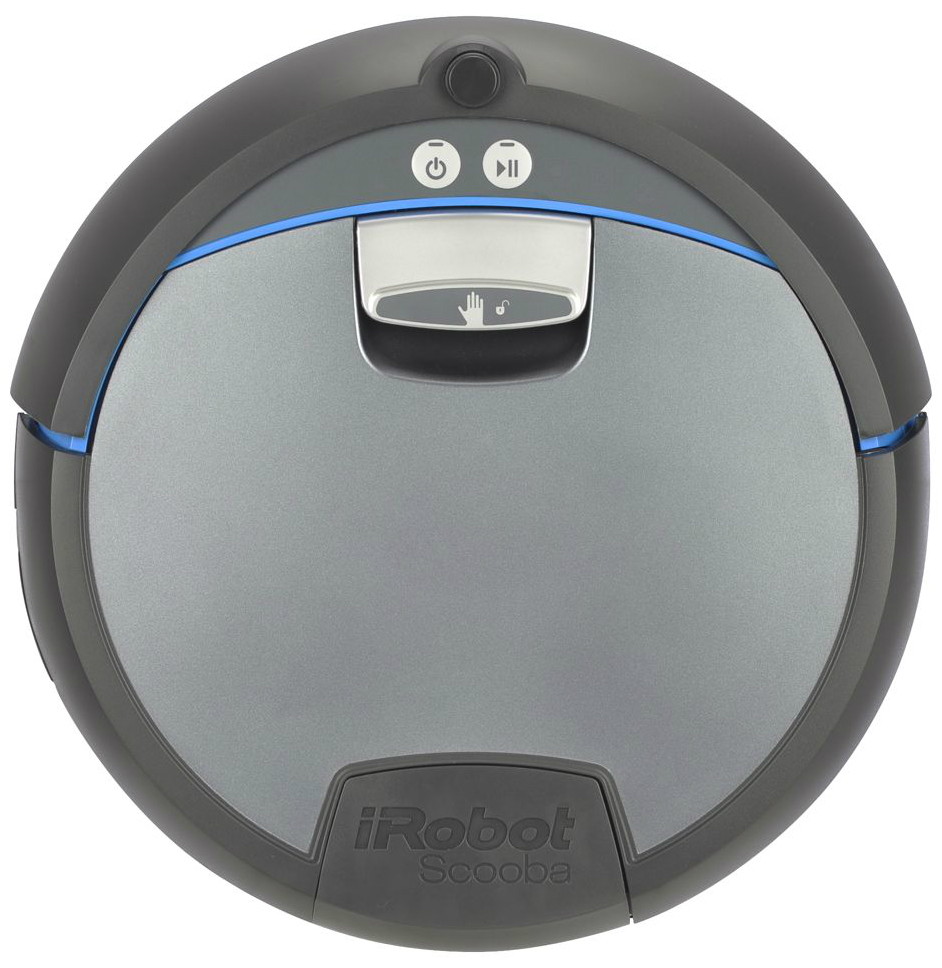
Evolution makes the claim that the Mint’s square body will allow it to clean surfaces better than round-bodied cleaners like the iRobot Scooba. The robot holds the cleaning pad in front of it, and has clearance on both sides of the robot behind the pad. The Mint is only 10 inches wide (and appears to be only a few inches tall) which makes it ideal to fit under furniture and between obstacles like chair legs.

Other technologies built into the robot:

  • Like Roombas, Mint has cliff detection so it won’t fall down stairs.
  • Mint will ship with reusable microfiber cloths.
  • Mint robots can detect where rugs are and will avoid driving on them.
  • The robot will adjust for different kinds of floors to ensure that it gets the best cleaning and can still get good traction on the floor.
  • The square shape of the robot enables it to clean into corners and along edges.
  • Battery life is expected to be 3 hours.
  • Since it has no bin to empty, Mint should be lower maintenance.

Mint is expected to be available for order in the third quarter of 2010, and in retail stores by the fourth quarter. Pricing is expected to be below US $250.

And it looks like a dinner mint would if it was a robot.

Bookmark and Share

In the Future, a Robot Gecko Will Clean Your Windows

Gecko Cleaning Robot on Glass Surface

Serbot AG, a Swiss robotics firm is designing what looks like a Scooba robot with legs for cleaning large solar panels. To accomplish this goal, they used parts manufactured by Festo. I don’t usually get into large pictures on this site, but this thing is really cool looking, and it’s rare to find such a cool looking thing that is also a cleaning robot.

I’ve never thought about this, but apparently keeping large solar panels clean is a real pain and can be dangerous. They get covered with leaves, dust, pollen, pollution, and everything else that falls on them. Solar farms often have to clean them at night, and I guess it’s not as simple as turning a hose on them. The photovoltaic panels are delicate, slippery, and usually tilted at an angle. As more and more solar farms are built with more and more solar panels, cleaning them is going to be a real issue.

This sounds like a great place to apply some robot elbow-grease. You just build (or buy) an army of these little suction-cup footed robots and equip them with brushes, wipers, and maybe a spray bottle and a vacuum hose? The cleaning robots are made with twenty suction-cup feet on two kidney-shaped carrier frames. As you can see from the photos, the carrier frames are chain tracks, which are attached by a bridge. I would guess that’s where you connect the cleaning devices. To move, the robot rotates the feet around the carrier frames. It looks to me like the feet in the center of the device are the ones that will be engaged with the surface it is cleaning.

Gekko Cleaning Robot Closeup

The robot is designed to know that it has reached the end of a solar panel by feel. Basically, if it can’t get a grip, it withdraws. While this sounds like a cool idea, I wonder why they can’t use something more sophisticated? They solved the problem of how to keep suction by making sure the robot is always moving. The feet which are in contact with the surface at any given time only keep suction for two seconds. This makes it so the robots can travel without using so much energy to hang on.

Photo Source: Festo

Bookmark and Share

iRobot Announces 5 Million Unit Milestone

In a press release today, iRobot Corporation (listed on the NASDAQ as IRBT) announced that they had passed the sales milestone of five million home robots. Five million! That’s a lot of robot vacuums. iRobot has been selling Roombas since 2002.

“This achievement represents a huge milestone for iRobot and for the robotics industry as a whole,” said Colin Angle, chairman and chief executive officer of iRobot. “We set out to create practical robots that help people accomplish tasks they don’t like to do, and in many cases, don’t have time to do. With over five million home robots sold, we have seen a widespread acceptance of this technology. This further fuels our drive to innovate and provide solutions that make a difference in people’s lives.”

The press release goes on to detail the achievements of the company and features of the robots which have propelled the popularity of its robot vacuum cleaners. Some of the features they talk about in the press release include:

  • The behavioral algorithms which make the robots clean floors more effectively.
  • Technology for detecting obstacles before the Roomba runs into them.
  • The low profile of the Roomba, which makes it ideal for vacuuming under furniture.
  • Dirt Detect: The robots sense dirt and change their behavior to spend more time in dirty areas.
  • Anti-tangle technology, which keeps the robot vacuums from getting caught on cables and fringes on rugs.
  • The spinning side brush.
  • Scheduling: So that you can have the robot clean your house when you’re not home.
  • Cliff detection to keep the vacuum cleaners from falling down stairs.
  • Automatic surface adjustment so that the robots can transition between different floor surfaces.
  • Round shape: Here’s one I haven’t thought about. iRobot says that the round shape of the Roombas helps keep them from getting stuck.
  • Home base with charger.

The press release goes on to detail the price range of Roombas, emphasizing that the entry-level robot is around US $129, and also mentions some of iRobot’s other robots for cleaning around the house. So the Scooba, Dirt Dog, Looj, and Verro. Here’s a link to the official press release on iRobot’s site.

Bookmark and Share